Workflow solution / Aviation operations
FlightOps
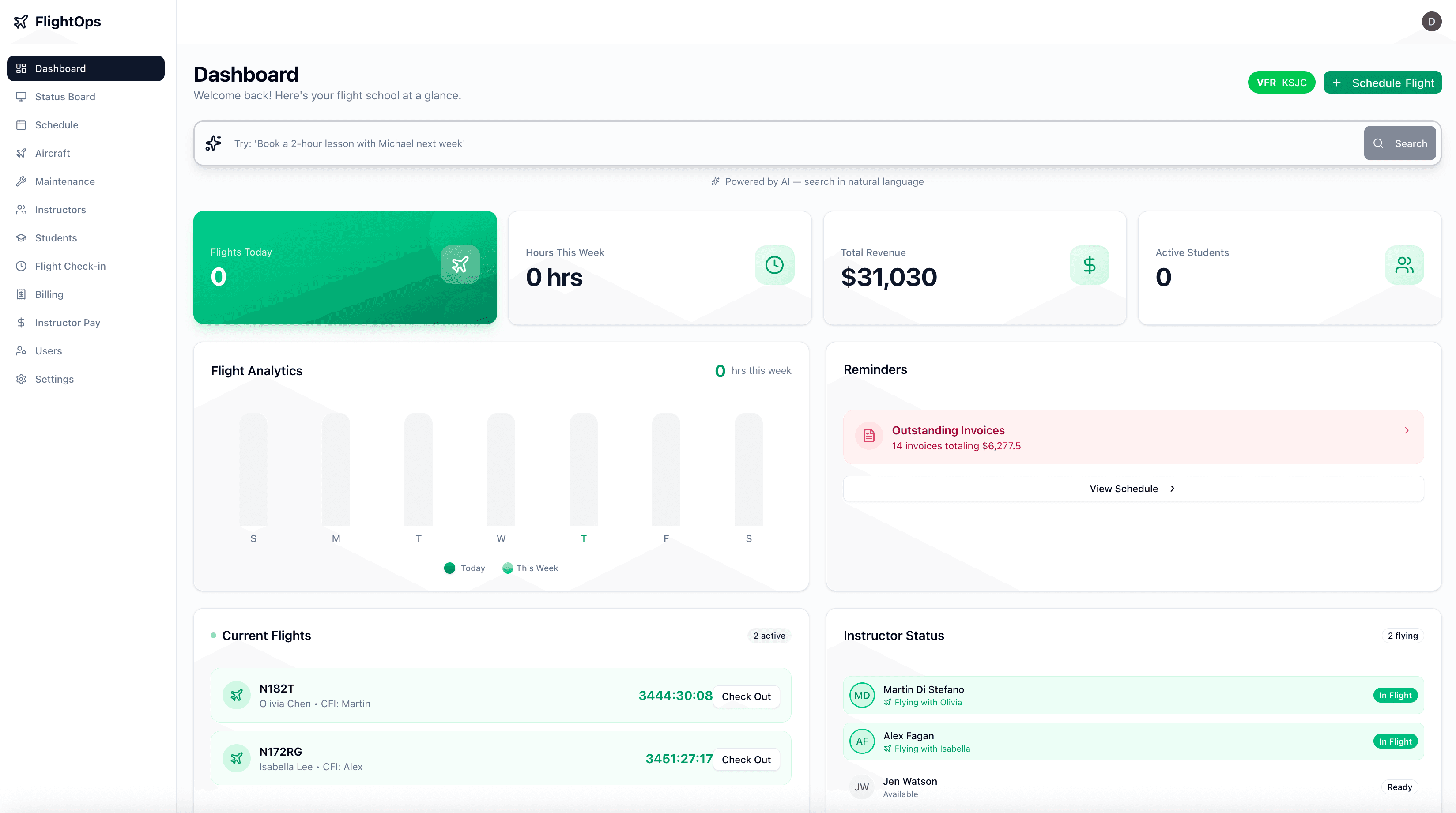
A comprehensive flight-school operating system for scheduling, billing, instructor pay, aircraft utilization, and Part 141 training operations.
A comprehensive flight school management system that maps the daily operating workflow: students, instructors, aircraft, scheduling, maintenance, flight check-in/out, Hobbs/Tach validation, invoices, payments, instructor compensation, and Part 141 training progress.
Status
Prototype
Timeline
Built as a full operational workflow system
Domain
Aviation operations
Why
Workflow solution
Stack
Languages, services, data sources, and operating pieces behind the build.
Code Proof
What The Build Actually Contains
LOC
26k+
Source files
135
Auth
Clerk
Ops
Scheduling
Product proof
Implementation
Code Behind The Surface
Protecting the schedule
tsThe core move behind the product surface.
const availableSlots = await findAvailability({
  aircraftType,
  instructorRating,
  dateRange,
  durationHours,
});

return rankByFit(availableSlots, studentPreference);
Product Model
tsThe useful answer has to be modeled before the UI can make it obvious.
type ProductSurface = {
  input: "Aviation operations";
  signal: "What would a flight school need if scheduling, aircraft availability, billing, instr";
  proof: string[];
};

const surface: ProductSurface = {
  input: "Aviation operations",
  signal: "Aircraft, instructors, students, billing, and pay in one operating loop.",
  proof: [
  "Weekly flight schedule",
  "Aircraft and instructor management",
  "Student roster and balances",
  "Flight check-in/check-out"
],
};
Hard Part
tsEvery build has a constraint: data quality, workflow shape, trust, speed, or operational risk.
const constraint = {
  project: "FlightOps",
  status: "Prototype",
  category: "Workflow solution",
  hardPart: "The business value is operational throughput. Cleaner scheduling, faster booking, accurate meter capture, conn...",
};

shipSurface(constraint);
Project Logic
Why This Exists
The useful part is the path: what was broken, what I built, and where the leverage showed up.
Mission
What would a flight school need if scheduling, aircraft availability, billing, instructor pay, maintenance, and Part 141 progress were treated as one operating workflow?
Flight schools run on scarce resources: aircraft, instructor hours, student availability, maintenance windows, training requirements, and billing accuracy. When those systems are disconnected, capacity leaks out of the business.
Build
What Had To Work
I built a management system with dashboards, weekly scheduling, aircraft and instructor management, student records, flight check-in/out, Hobbs/Tach validation, maintenance tracking, invoices, payments, instructor pay, natural-language availability search, and a Part 141 training tracker.
Why It Matters
Schedule -> flight -> invoice
Connects the operational layer that determines aircraft capacity, billing accuracy, instructor pay, and Part 141 progress.
Hard Parts
The Workflow Is Not One Screen
FlightOps had to connect scarce aircraft, instructor calendars, student progress, maintenance status, meter readings, billing, and pay records without turning the operator experience into a spreadsheet.
Meter Readings Drive Money And Maintenance
Hobbs and Tach entries affect invoices, instructor pay, utilization, and maintenance timing, so the system includes validation instead of treating flight check-out as a loose text form.
Part 141 Adds A Training Layer
The build includes Part 141 course tracking, lesson completion, instructor notes, and seeded Sporty's Private Pilot curriculum structure tied back into the student workflow.
Decisions
Proof
Prototype artifact with inspectable product surface, implementation details, and proof points.
LOC: 26k+
Source files: 135
Auth: Clerk
Weekly flight schedule
Aircraft and instructor management
Student roster and balances
Tell Me About Your Project
Bring Me The Bottleneck.
I’ll Build The Answer.
Tell me what people are trying to do, where the current path breaks, and what kind of useful answer should exist.
Market Gap
Demand exists, but the answer is missing.
Workflow Drag
The work is still too manual, slow, or scattered.
Product Wedge
A small surface could prove the larger opportunity.