PLG / activation wedge / Recruiting
Dover Hiring Planner
A self-serve hiring planner built from Dover's marketplace data.
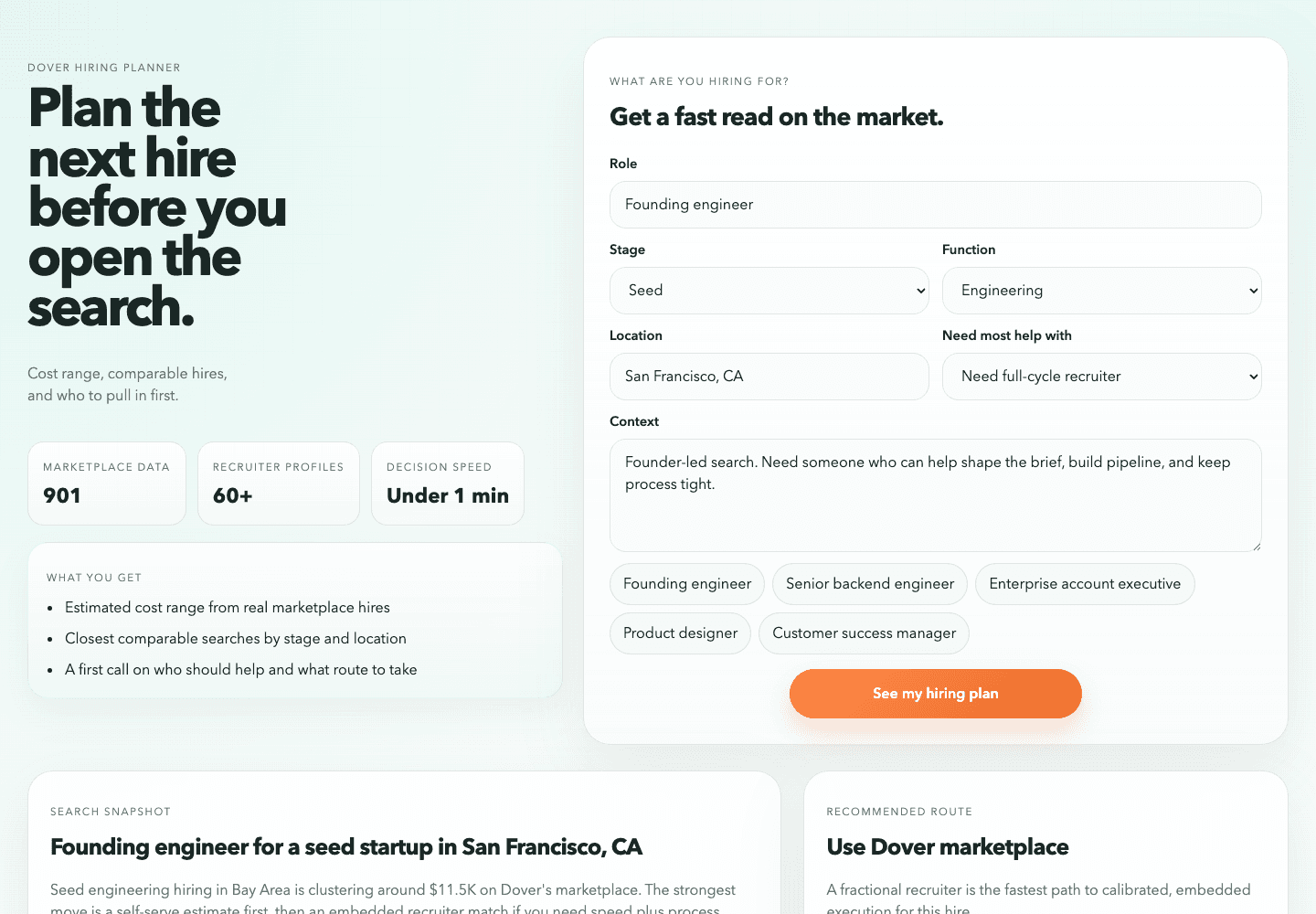
A PLG-style planner that helps a founder understand likely hiring cost, comparable searches, who should help first, and whether a marketplace route makes sense.
Status
Prototype
Timeline
Built from Dover's public 901-row benchmark dataset
Domain
Recruiting
Why
PLG / activation wedge
Stack
Languages, services, data sources, and operating pieces behind the build.
Code Proof
What The Build Actually Contains
LOC
3.5k+
Source files
43
Backend
Django
Data
901 rows
Product proof
Implementation
Code Behind The Surface
Planning before the sales handoff
tsThe core move behind the product surface.
const plan = planHiring({
  roleTitle,
  companyStage,
  companyLocation,
  hiringPriority,
});

routeQualifiedDemand(plan.fit, plan.urgency);
Product Model
tsThe useful answer has to be modeled before the UI can make it obvious.
type ProductSurface = {
  input: "Recruiting";
  signal: "What could a founder learn before opening a search if the marketplace data were pack";
  proof: string[];
};

const surface: ProductSurface = {
  input: "Recruiting",
  signal: "Cost, comparable searches, and who should help first.",
  proof: [
  "Self-serve hiring plan",
  "Cost range estimation",
  "Comparable search matching",
  "Recruiter route recommendation"
],
};
Hard Part
tsEvery build has a constraint: data quality, workflow shape, trust, speed, or operational risk.
const constraint = {
  project: "Dover Hiring Planner",
  status: "Prototype",
  category: "PLG / activation wedge",
  hardPart: "This is a classic PLG wedge: make the first useful answer available without a call, then use that interaction ...",
};

shipSurface(constraint);
Project Logic
Why This Exists
The useful part is the path: what was broken, what I built, and where the leverage showed up.
Mission
What could a founder learn before opening a search if the marketplace data were packaged as a product?
Hiring-marketplace demand starts before the transaction. Founders want to know cost range, comparable searches, route fit, and who should help before they commit to a search motion.
Build
What Had To Work
I built a planner backed by normalized benchmark data that gives an immediate recommendation and fallback frontend logic if the API is unavailable.
Why It Matters
901 benchmark hires
Compresses the first hiring-fit question into a self-serve plan instead of a sales conversation.
Hard Parts
Make The Signal Useful
Answer the founder's first hiring question before asking for a sales call.
Turn The Work Into A System
I built a planner backed by normalized benchmark data that gives an immediate recommendation and fallback frontend logic if the API is unavailable.
Prove The Wedge
This is a classic PLG wedge: make the first useful answer available without a call, then use that interaction to reveal fit, urgency, and buying context.
Decisions
Proof
Prototype artifact with inspectable product surface, implementation details, and proof points.
LOC: 3.5k+
Source files: 43
Backend: Django
Self-serve hiring plan
Cost range estimation
Comparable search matching
Tell Me About Your Project
Bring Me The Bottleneck.
I’ll Build The Answer.
Tell me what people are trying to do, where the current path breaks, and what kind of useful answer should exist.
Market Gap
Demand exists, but the answer is missing.
Workflow Drag
The work is still too manual, slow, or scattered.
Product Wedge
A small surface could prove the larger opportunity.